Interpreting Peptide Discussions Online Retra Labs UK
Learn how to assess online peptide discussions, spot common claims, check research sources and separate social trends from evidence.
Interpreting Peptide Discussions Online
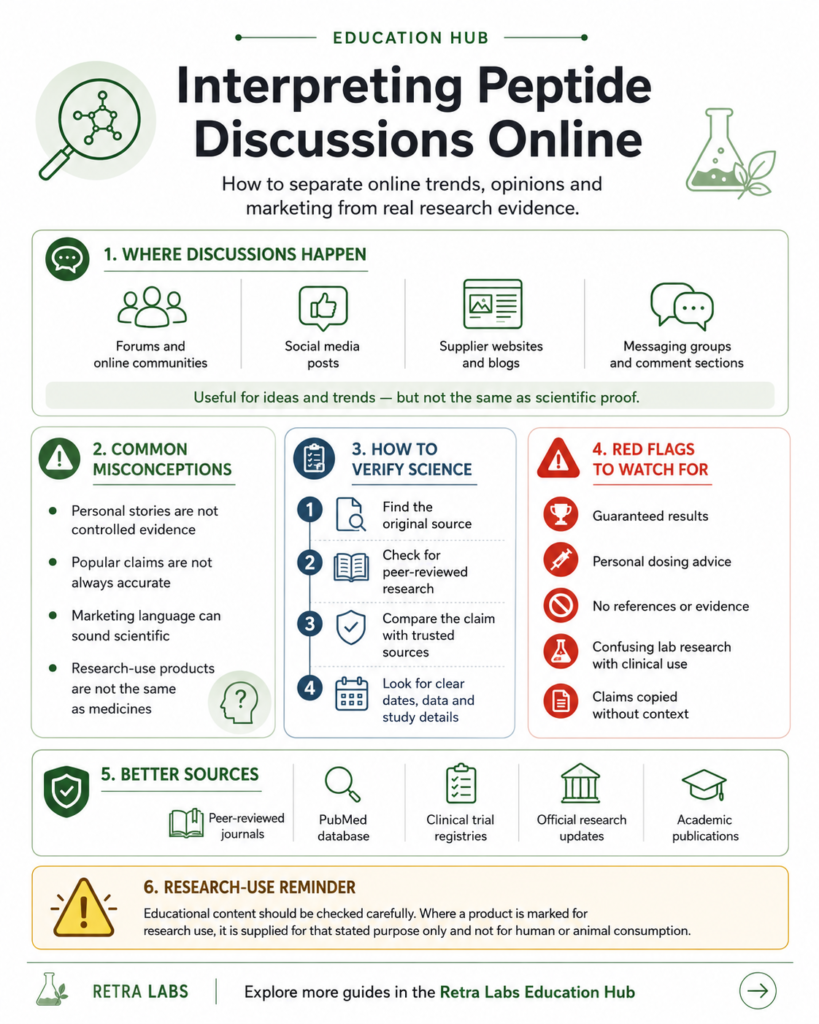
Online discussions about peptides can be useful, but they can also be confusing. Forums, social media posts, Telegram groups and comment sections often mix real research, personal opinions, marketing claims and speculation.
This guide explains how to read peptide discussions more carefully. It is written for educational and research use purposes only. It does not provide medical advice, dosing guidance or personal use recommendations.
Why Peptide Discussions Are Popular Online
Peptides such as Retatrutide, Semaglutide and Tirzepatide are widely discussed because they are linked to fast moving areas of metabolic research. As a result, many people search online for simple explanations, comparison posts and research summaries.
However, online posts are not the same as scientific evidence. A post may describe an experience, repeat a claim or promote a product. Therefore, it is important to check where the information came from before relying on it.
For example, Retatrutide has been studied as a triple hormone receptor agonist involving GLP-1, GIP and glucagon receptors. Published Phase 2 research is available in peer-reviewed sources, including the New England Journal of Medicine and PubMed.
Common Places People Discuss Peptides
Peptide discussions often appear on:
- Reddit communities
- Telegram groups
- YouTube comments
- TikTok and Instagram posts
- Private forums
- Supplier websites
- Blog articles
- News pages
Each source has a different level of reliability. For example, a peer reviewed study carries more weight than an anonymous comment. Likewise, a clinical trial registry or official company update should be treated differently from a viral social media post.
Common Misconceptions to Watch For
One common mistake is treating every peptide post as scientific proof. Personal stories can be interesting, but they do not show controlled evidence.
Another issue is terminology. For example, Lilly states that “GLP-3” is not a scientifically accurate classification for Retatrutide. The better term is “triple agonist,” because Retatrutide targets GLP-1, GIP and glucagon receptors.
You may also see claims that Retatrutide is approved, prescribed or available as a medicine. At the time of the cited Lilly information, Retatrutide is described as investigational and not FDA approved. In the UK, users can check authorised medicine information through MHRA product information services.
How to Check Whether a Claim Is Reliable
First, look for the original source. If a post mentions a study, search for the trial or paper directly.
Next, check whether the source is:
- Peer reviewed
- Published by a recognised journal
- Listed on PubMed
- Connected to a registered clinical trial
- From a regulator or official company source
- Clearly dated and updated
Then, compare the claim with other sources. If only one anonymous post says something and no study supports it, treat it carefully.
Finally, check the wording. Strong claims like “proven,” “guaranteed,” or “works for everyone” should be treated with caution.
Online Trends vs Research Evidence
Online trends move quickly. Research moves more slowly. That is normal.
A trending post may appear before a full paper is published. Therefore, it may not include full data, study limitations or safety details. In contrast, peer-reviewed studies usually explain methods, participant numbers, results and limitations.
For Retatrutide, Phase 2 research reported dose dependent body weight changes over 24 and 48 weeks in a controlled clinical study. However, this does not mean online products should be treated as clinical medicines. It means researchers should review the original evidence carefully and keep research use boundaries clear.
Red Flags in Peptide Discussions
Be cautious when a post:
- Gives personal dosing advice
- Claims guaranteed results
- Ignores research use wording
- Uses fake medical language
- Shows no source or reference
- Confuses animal, lab and human data
- Uses copied screenshots without context
- Promotes a product without explaining quality checks
- Says “everyone is using it” as proof
Also, be careful with posts that mix several peptides, compounds or protocols without explaining the research context.
A Better Way to Read Peptide Content
A more reliable approach is to ask simple questions.
What is the source?
Is it peer reviewed?
Is it a personal opinion?
Does it mention research use only?
Is the claim about a study, a product or a personal result?
Can the information be checked somewhere else?
This makes it easier to separate useful research discussion from hype.
Useful Sources for Verification
For research checks, use sources such as:
- PubMed Research Database
- Clinical trial registries
- MHRA product information services
- Peer-reviewed journals
- Manufacturer research updates
- University or academic publications
For general peptide education, you can also read our internal guides:
- What Is Retatrutide? A Research Focused Overview
- Retatrutide in Research: What the Evidence Shows
- Peptide Storage & Handling for Lab Research
- Laboratory Guide: Reconstituting & Preparing Research Peptides
- Retatrutide vs Other Metabolic Peptides
- Preparation Essentials Explained
Research Use Reminder
Retra Labs provides educational content for research use product settings only. Our content is not medical advice and should not be used as personal use guidance.
Where a product is marked for research use, it is supplied for that stated purpose only. It is not supplied for human or animal consumption, diagnosis, treatment or prevention of disease.