Triple Agonist vs Dual Agonist Peptides Explained UK
Learn the difference between triple agonist and dual agonist peptides in research, including GLP-1, GIP and glucagon pathways.
Triple Agonist vs Dual Agonist Peptides
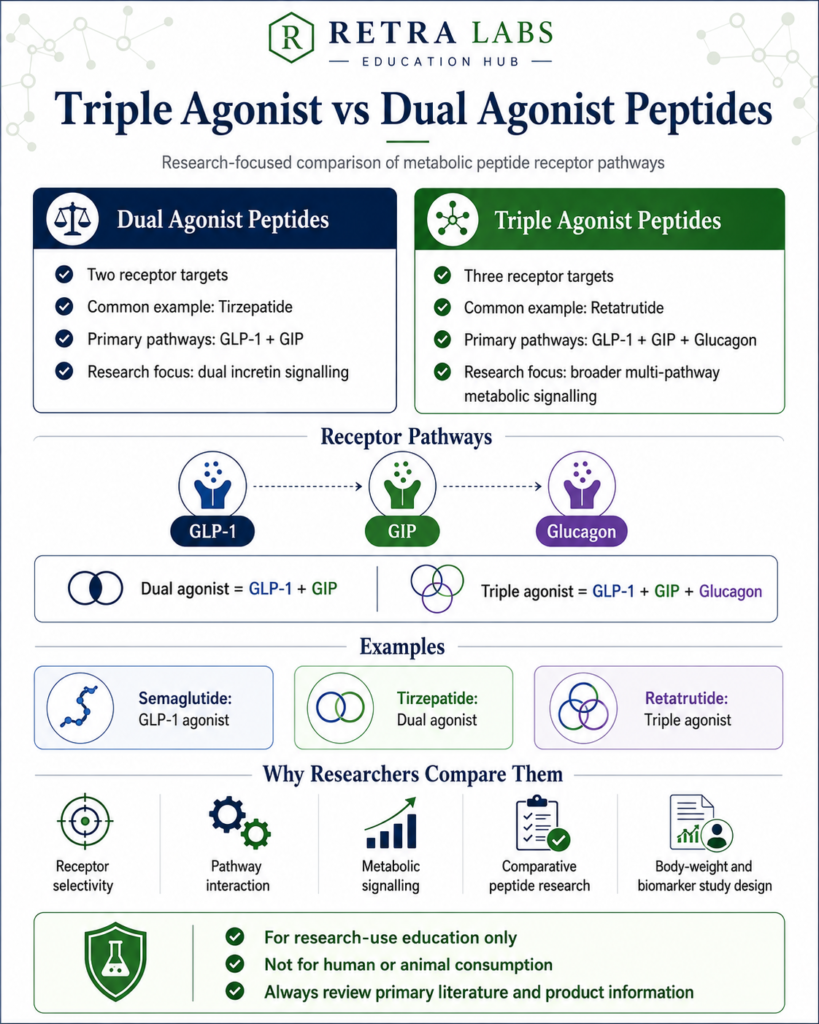
Triple agonist and dual agonist peptides are important topics in modern metabolic peptide research. They are often discussed because they target more than one receptor pathway. This makes them different from single pathway peptides, such as GLP-1-only agonists.
This guide explains the difference between triple agonist and dual agonist peptides in a research use context. It focuses on GLP-1, GIP and glucagon receptor pathways, with examples such as Retatrutide and Tirzepatide.
This page is for education only. It does not provide medical advice, dosing guidance or personal use recommendations.
Quick Overview: Dual Agonist vs Triple Agonist
| Feature | Dual Agonist Peptides | Triple Agonist Peptides |
|---|---|---|
| Number of receptor pathways | Two | Three |
| Common example | Tirzepatide | Retatrutide |
| Main receptor targets | Usually GLP-1 + GIP | Usually GLP-1 + GIP + glucagon |
| Research focus | Dual incretin signalling | Multi-pathway metabolic signalling |
| Key comparison term | Dual receptor activity | Triple receptor activity |
What Is a Dual Agonist Peptide?
A dual agonist peptide is designed to activate two receptor pathways. In metabolic peptide research, the best known example is Tirzepatide, which acts on both the GIP and GLP-1 receptors. The FDA label describes Tirzepatide as a GIP receptor and GLP-1 receptor agonist.
In simple terms:
Dual agonist = two receptor targetsFor Tirzepatide, those targets are:
GIP + GLP-1This dual action is useful in research because it allows scientists to study how two incretin related pathways interact. As a result, dual agonist peptides are often compared with GLP-1-only peptides and newer triple agonist compounds.
What Is a Triple Agonist Peptide?
A triple agonist peptide is designed to activate three receptor pathways. In Retatrutide research, those pathways are GIP, GLP-1 and glucagon. The NEJM Retatrutide study describes Retatrutide as an agonist of the glucose dependent insulinotropic polypeptide, glucagon like peptide-1 and glucagon receptors.
In simple terms:
Triple agonist = three receptor targetsFor Retatrutide, those targets are:
GIP + GLP-1 + glucagonThis makes Retatrutide different from Tirzepatide. Tirzepatide is a dual agonist. Retatrutide is a triple agonist.
Why GLP-1, GIP and Glucagon Matter
GLP-1, GIP and glucagon are key pathways in metabolic research. Each pathway gives researchers a different view of metabolic signalling.
GLP-1 Pathway
GLP-1 receptor research is often linked with glucose regulation, insulin secretion, gastric emptying and appetite signalling. It is one of the most established areas of metabolic peptide research.
GIP Pathway
GIP receptor research is linked with nutrient response, insulin secretion and adipose tissue signalling. When combined with GLP-1 activity, GIP helps researchers study dual incretin effects.
Glucagon Pathway
Glucagon receptor research is linked with hepatic glucose output, fasting state metabolism and energy balance. This pathway is one of the key reasons triple agonist peptides are studied separately from dual agonists.
Main Difference Between Dual and Triple Agonists
The main difference is simple:
Dual agonists activate two receptor pathways.
Triple agonists activate three receptor pathways.
However, the research implications are more complex. A dual agonist, such as Tirzepatide, helps researchers examine combined GIP and GLP-1 signalling. A triple agonist, such as Retatrutide, adds glucagon receptor activity. Therefore, triple agonist peptides may help researchers examine broader metabolic pathway interaction.
A 2024 review on dual and triple agonists discusses GLP-1 receptor agonists, dual GLP-1/GIP receptor co agonists, and GLP-1/GIP/glucagon triple agonists as part of the same developing research area.
Retatrutide vs Tirzepatide as Examples
The easiest way to understand the class difference is to compare Retatrutide and Tirzepatide.
Tirzepatide = dual agonist peptide = GIP + GLP-1
Retatrutide = triple agonist peptide = GIP + GLP-1 + glucagon
This difference is why Retatrutide is often discussed as a next generation metabolic peptide in research. It is not simply another version of Tirzepatide. It has a different receptor profile.
Research Evidence: Why the Comparison Matters
Tirzepatide has an established clinical research base. In the SURMOUNT-1 trial, once-weekly Tirzepatide produced substantial and sustained body weight reductions over 72 weeks in participants with obesity.
Retatrutide has also produced strong research interest. In the Phase 2 NEJM trial, Retatrutide treatment over 48 weeks led to substantial body weight reductions in participants with obesity.
More recent Lilly communications have reported late stage Retatrutide trial findings, including large average body weight reductions in Phase 3 research. However, researchers should always review original publications, trial data and official updates before drawing conclusions from headlines or online summaries.
Why Researchers Study Multi-Receptor Peptides
Researchers study dual and triple agonist peptides because metabolic pathways do not work in isolation. Instead, signalling systems interact.
A research comparison may look at:
Receptor selectivity
Signal strength
Pathway overlap
Insulin secretion
Glucagon regulation
Energy balance
Body weight outcomes
Glycaemic markers
Lipid markers
Tolerability signals
Peptide stability
Development stage
This type of comparison helps researchers understand whether wider receptor activity changes metabolic signalling patterns.
Dual Agonist Peptides: Research Strengths
Dual agonist peptides are useful because they allow researchers to study two related pathways together. For example, GLP-1 and GIP are both incretin related pathways. Studying them together can help explain how combined incretin receptor activity differs from GLP-1-only activity.
Dual agonist research may focus on:
GLP-1 and GIP receptor interaction
Incretin pathway biology
Glucose-dependent insulin secretion
Appetite and metabolic signalling
Comparison with GLP-1-only compounds
Triple Agonist Peptides: Research Strengths
Triple agonist peptides add a third pathway. In Retatrutide research, the additional pathway is glucagon receptor activity.
Triple agonist research may focus on:
GLP-1, GIP and glucagon receptor interaction
Multi-pathway metabolic signalling
Energy balance research
Comparative peptide pharmacology
Broader biomarker analysis
Because triple agonists involve more pathways, they may be useful in advanced receptor comparison studies.
Development Status and Research Context
For UK readers, it is important to separate research education from product use. Some dual agonist peptides, such as Tirzepatide, are approved medicines in certain markets and for specific indications. Retatrutide remains investigational while clinical research continues.
This page is not suggesting any compound for personal use. It is written to explain peptide classes and receptor pathway differences in a research use context.
Common Misconceptions
“Triple agonist means stronger in every way”
Not necessarily. Triple agonist means three receptor pathways are involved. It does not automatically mean better for every research question. The value depends on the study design, receptor target and outcome being measured.
“Dual agonists and triple agonists are the same”
They are not the same. Dual agonists involve two receptor pathways. Triple agonists involve three.
“All metabolic peptides work through GLP-1 only”
This is incorrect. Some peptides target GLP-1 only, some target GLP-1 and GIP, and others target GLP-1, GIP and glucagon.
Why This Matters for Retatrutide Research
Retatrutide is often searched because it sits at the centre of triple agonist research. Understanding the difference between dual and triple agonists helps readers understand why Retatrutide is different from Tirzepatide and Semaglutide.
A simple summary is:
Semaglutide = GLP-1 pathway
Tirzepatide = GLP-1 + GIP pathways
Retatrutide = GLP-1 + GIP + glucagon pathways
This pathway map is useful for education, comparison content and research planning.
Internal Links to Add
Add these links inside the page where relevant:
What Is Retatrutide? A Research-Focused Overview
Retatrutide in Research: What the Evidence Shows
Retatrutide vs Tirzepatide: Research Comparison
Retatrutide vs Semaglutide: Research Comparison
GLP-1 vs GIP vs Glucagon: Receptor Pathways Explained
Peptide Storage & Handling for Lab Research
Laboratory Guide: Reconstituting & Preparing Research Peptides
Education Hub
Retatrutide Product Page
Research Use Reminder
Retra Labs provides educational content for research use product settings only. This guide is not medical advice and should not be used to guide personal decisions.
Where a product is marked for research use, it is supplied only for its stated research purpose. It is not supplied for human or animal consumption, diagnosis, treatment or prevention of disease.
FAQ Section
What is a dual agonist peptide?
A dual agonist peptide is a compound designed to activate two receptor pathways. In metabolic peptide research, Tirzepatide is a common example because it targets GIP and GLP-1 receptors.
What is a triple agonist peptide?
A triple agonist peptide is a compound designed to activate three receptor pathways. Retatrutide is a common research example because it targets GIP, GLP-1 and glucagon receptors.
What is the difference between dual and triple agonists?
The main difference is the number of receptor pathways involved. Dual agonists activate two pathways, while triple agonists activate three.
Is Retatrutide a triple agonist?
Yes. Retatrutide is described in research literature as an agonist of GIP, GLP-1 and glucagon receptors.
Is Tirzepatide a dual agonist?
Yes. Tirzepatide is described as a GIP receptor and GLP-1 receptor agonist.
Why do researchers compare dual and triple agonists?
Researchers compare them to understand how different receptor combinations affect metabolic signalling, pathway interaction and study outcomes.
Is this page medical advice?
No. This page is for education and research use context only. It does not provide medical advice, dosing guidance or personal-use recommendations.