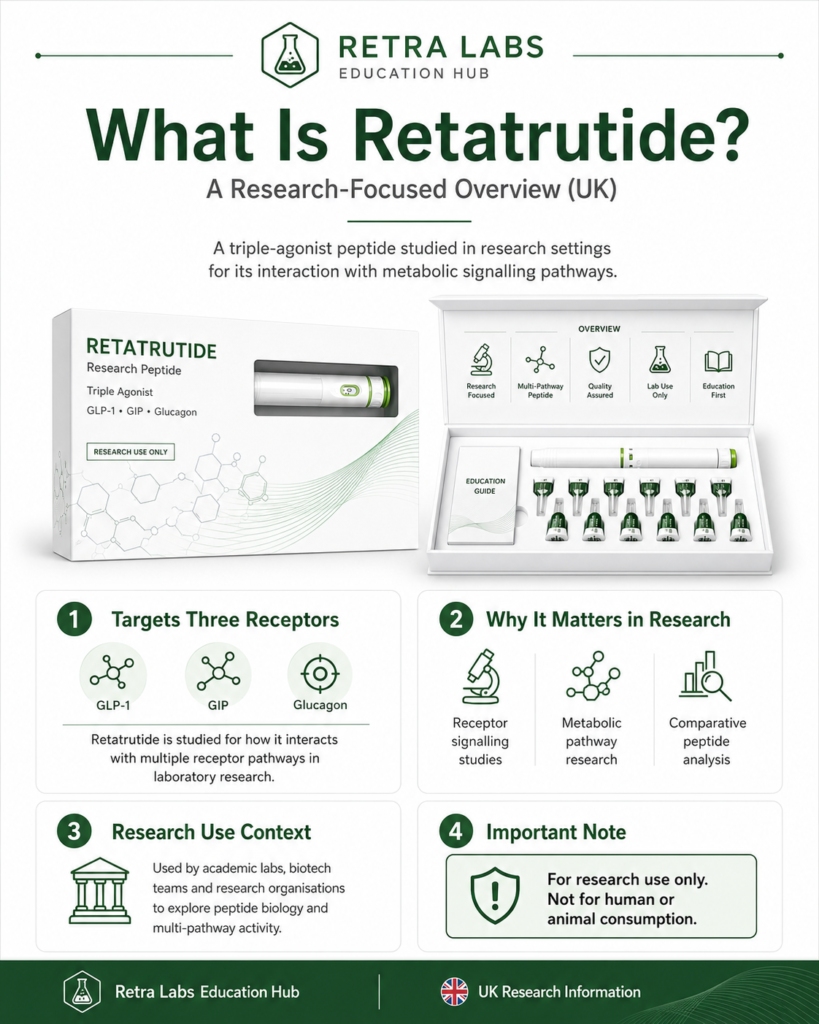
What Is Retatrutide?
Research Overview UK Retra Labs
Learn what Retatrutide is and how it works in research settings. UK focused guidance on mechanisms, receptors, and research roles — for laboratory use only.
A Research Focused Overview (UK)
Retatrutide is an investigational peptide compound used in laboratory research to study interactions with metabolic pathways. It acts on multiple receptor targets, giving researchers a tool to explore complex biological signalling. Because Retatrutide is supplied for research use only, it must not be used for human or animal consumption or any clinical purpose.
This page explains Retatrutide’s scientific profile, mechanism of action, and why it is of interest in research environments.
1. Retatrutide in Research
Retatrutide is classified as a multi‑agonist peptide. In research settings, scientists use it to investigate how multiple hormonal pathways interact to influence metabolism and cellular responses.
Typically, Retatrutide research focuses on:
- receptor binding profiles,
- metabolic signalling cascades,
- comparative analyses with other peptides.
Research institutions in the UK and internationally publish studies on peptide biology, enabling academic labs to build on existing data. For reference materials, see the PubMed Research Database.
2. Mechanism of Action Scientific Breakdown
Retatrutide interacts with three receptor families found in metabolic tissues:
GLP‑1 Receptors
These receptors play key roles in glucose regulation and appetite signalling in research models. GLP‑1 receptor activity is a frequent target in peptide research.
GIP Receptors
GIP receptors are involved in nutrient‑induced insulin secretion research. Dual activity with GLP‑1 provides insight into combined signalling effects.
Glucagon Receptors
Glucagon receptors are studied for their role in hepatic glucose production and metabolic regulation. Retatrutide’s agonist profile helps delineate glucagon pathway involvement.
By acting on all three, Retatrutide enables multifaceted exploration of metabolic receptor crosstalk.
3. Structure & Classification
Retatrutide is a synthetic peptide a short chain of amino acids designed to mimic natural hormone sequences while stabilising key receptor interactions. In biochemical research, peptides are often used as probes to understand receptor functionality and downstream effects.
Retatrutide research may involve:
- peptide stability assays,
- receptor binding studies,
- signal transduction measurements.
Unlike small molecules, peptides provide high specificity in receptor studies.
4. UK Research Context
In the UK, Retatrutide is frequently used in academic and industrial laboratories studying metabolic biology or peptide pharmacology. Institutions may include university research groups, biotech startups, and dedicated peptide research labs.
It is crucial to note that Retatrutide is not approved for clinical use in the UK — this guide is purely for research understanding. For broader comparison studies involving GLP‑1 and related peptides, see our Comparison: Retatrutide vs Other Peptides guide.
5. Internal & External References
Internal Links:
External Links:
- PubMed Research Database — https://pubmed.ncbi.nlm.nih.gov/
6. Summary for UK Researchers
In summary, Retatrutide is a valuable research tool for studying multi pathway peptide signalling in laboratory environments. It helps inform biochemical research, receptor characterisation, and metabolic investigations. Whenever using Retatrutide in a research setting, make sure to adhere to UK laboratory protocols and safety practices, such as those outlined in our Storage & Handling Basics guide.