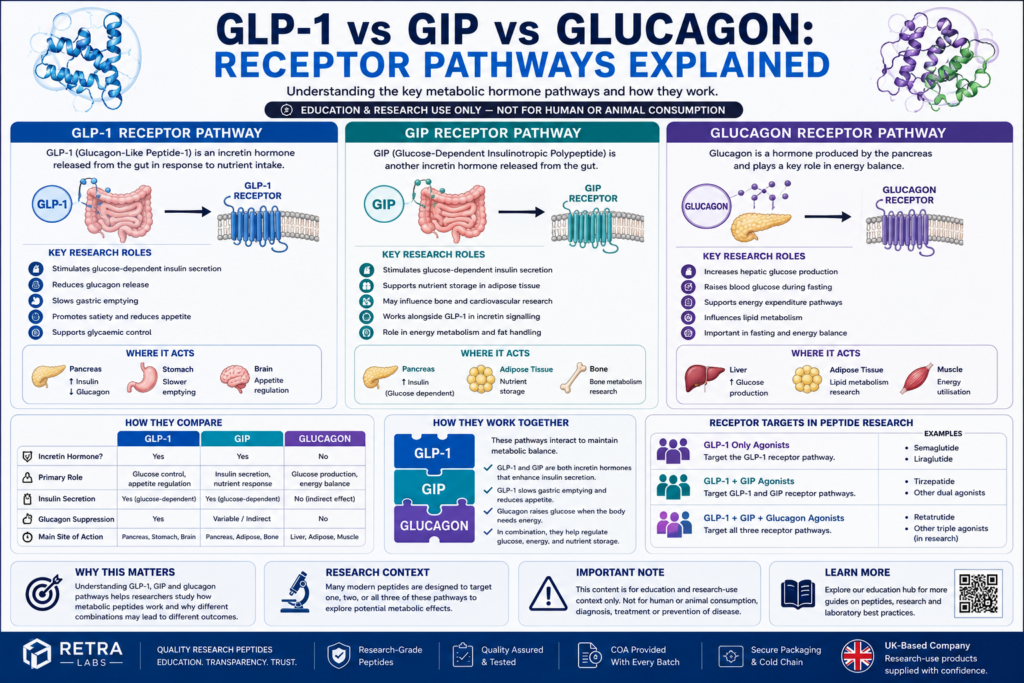
GLP-1 vs GIP vs Glucagon:
Learn how GLP-1, GIP and glucagon receptor pathways differ in peptide research, including signalling roles and metabolic study relevance.
GLP-1 vs GIP vs Glucagon: Receptor Pathways Explained
GLP-1, GIP and glucagon are important hormone pathways in metabolic research. They are often discussed together because modern peptide research increasingly studies how these pathways interact. This is especially relevant for compounds such as Retatrutide, which is researched for activity across GIP, GLP-1 and glucagon receptors.
This guide explains the difference between GLP-1, GIP and glucagon receptor pathways in a clear, research focused way. It is for education only and does not provide medical advice, dosing guidance or personal use recommendations.
Quick Overview: GLP-1 vs GIP vs Glucagon
| Pathway | Full Name | Main Research Interest |
|---|---|---|
| GLP-1 | Glucagon-like peptide-1 | Glucose regulation, appetite signalling, gastric emptying |
| GIP | Glucose-dependent insulinotropic polypeptide | Incretin signalling, insulin secretion, nutrient response |
| Glucagon | Glucagon receptor pathway | Hepatic glucose output, energy balance, metabolic regulation |
GLP-1 and GIP are often called incretin hormones. Incretins are gut derived hormones that help regulate insulin secretion after nutrient intake. GLP-1 and GIP are the two main incretin hormones described in metabolic research.
What Is the GLP-1 Receptor Pathway?
GLP-1 stands for glucagon like peptide-1. It is a peptide hormone linked to several areas of metabolic research, including insulin secretion, glucagon regulation, gastric emptying and appetite signalling.
In simple terms, GLP-1 receptor research focuses on how GLP-1 signalling affects glucose and energy balance. Reviews describe GLP-1 receptor activation as increasing insulin secretion, reducing glucagon release, delaying gastric emptying and reducing food intake through central appetite pathways.
For peptide research, GLP-1 is important because it is a well established receptor pathway. Many metabolic peptide studies use GLP-1 activity as a core reference point.
What Is the GIP Receptor Pathway?
GIP stands for glucose dependent insulinotropic polypeptide. Like GLP-1, it is an incretin hormone. It is secreted in response to nutrients and is studied for its role in insulin secretion and metabolic signalling.
GIP and GLP-1 are both described as primary incretin hormones that stimulate insulin secretion after glucose or nutrient ingestion. However, they are not identical. Research reviews note that GLP-1 and GIP have overlapping but distinct roles, including differences in glucagon regulation and broader metabolic effects.
In modern peptide research, GIP is often studied alongside GLP-1 because dual activation can help researchers explore combined incretin pathway effects.
What Is the Glucagon Receptor Pathway?
Glucagon is another hormone pathway involved in metabolic regulation. It is closely linked to hepatic glucose production, energy balance and nutrient state responses.
In research settings, glucagon receptor activity is studied because it can influence glucose output from the liver and broader energy metabolism. This makes glucagon different from GLP-1 and GIP, which are commonly discussed as incretin hormones.
The glucagon pathway becomes especially important when studying triple agonist peptides. These compounds are designed to involve GLP-1, GIP and glucagon receptor activity together.
Why These Pathways Matter in Retatrutide Research
Retatrutide is often discussed because it is researched as a triple agonist peptide. That means it is designed to interact with three receptor pathways:
GLP-1 + GIP + GlucagonThis differs from single receptor peptide research, such as GLP-1-only approaches, and dual-receptor peptide research, such as GLP-1 plus GIP approaches.
As a result, Retatrutide research raises a useful scientific question:
What happens when three metabolic receptor pathways are studied together?That question is why GLP-1 vs GIP vs glucagon comparison pages can be useful for researchers and readers trying to understand the field.
GLP-1, GIP and Glucagon: Key Differences
1. GLP-1 Is Often Linked to Appetite and Glucose Signalling
GLP-1 receptor activation is widely studied for its effects on insulin secretion, glucagon suppression, gastric emptying and appetite related pathways. This makes it a central pathway in metabolic peptide research.
2. GIP Is Closely Linked to Nutrient Response
GIP is also an incretin hormone. It is studied for glucose dependent insulin secretion and nutrient response. Therefore, it is often compared with GLP-1 in incretin biology.
3. Glucagon Is More Linked to Energy and Liver Glucose Output
Glucagon receptor research often focuses on liver glucose output, fasting-state metabolism and energy balance. This gives it a different research role compared with GLP-1 and GIP.
4. Combined Pathway Research Is Growing
Modern peptide research increasingly studies combined receptor activation. Examples include GLP-1/GIP dual agonists and GLP-1/GIP/glucagon triple agonists. This helps researchers explore whether combined pathway activity changes metabolic outcomes.
Why Researchers Compare These Receptors
Researchers compare GLP-1, GIP and glucagon because each pathway gives different information.
A comparison may focus on:
Receptor selectivity
Signal transduction
Insulin secretion
Glucagon release
Gastric emptying
Appetite signalling
Energy expenditure
Hepatic glucose production
Metabolic biomarkers
Peptide class differences
This type of comparison helps explain why Semaglutide, Tirzepatide and Retatrutide are not identical, even though they are often discussed in the same online searches.
How This Helps Compare Metabolic Peptides
Understanding these receptor pathways makes peptide comparison easier.
For example:
Semaglutide = GLP-1 receptor agonist
Tirzepatide = GIP + GLP-1 receptor agonist
Retatrutide = GIP + GLP-1 + glucagon receptor agonist
This structure helps readers understand the difference between single agonist, dual agonist and triple agonist peptide research.
UK Research Context
UK search interest around GLP-1, GIP and glucagon is growing because many readers are trying to understand metabolic peptide research and new investigational compounds. However, it is important to keep the distinction clear between research education, approved medicines and research use products.
Retra Labs content is provided for education and research use product settings only. It is not medical advice and should not be used to guide personal decisions.
Internal Links to Add
Add these links where relevant:
What Is Retatrutide? A Research-Focused Overview
Retatrutide in Research: What the Evidence Shows
Retatrutide vs Tirzepatide: Research Comparison
Retatrutide vs Semaglutide: Research Comparison
Peptide Storage & Handling for Lab Research
Laboratory Guide: Reconstituting & Preparing Research Peptides
Education Hub
Retatrutide Product Page
External References to Add
Use these as external sources:
PubMed Research Database
GLP-1 receptor mechanism review
GIP and GLP-1 incretin hormone review
Glucagon physiology research
Retatrutide Phase 2 NEJM study
Research-Use Reminder
This guide is for education and research use context only. It does not provide medical advice, dosing guidance or personal use recommendations.
Where a product is marked for research use, it is supplied only for its stated research purpose. It is not supplied for human or animal consumption, diagnosis, treatment or prevention of disease.
FAQ Section
What is the difference between GLP-1, GIP and glucagon?
GLP-1 and GIP are incretin hormones linked to nutrient response and insulin secretion. Glucagon is more closely linked to liver glucose output and energy balance.
Which receptor pathways does Retatrutide target?
Retatrutide is researched as a triple agonist involving GIP, GLP-1 and glucagon receptor pathways.
Is GLP-1 the same as GIP?
No. GLP-1 and GIP are both incretin hormones, but they have different receptor pathways and different roles in metabolic research.
Why is glucagon included in triple agonist research?
Glucagon receptor activity is studied because of its role in hepatic glucose output, energy regulation and broader metabolic signalling.
How does this relate to Semaglutide and Tirzepatide?
Semaglutide is linked to GLP-1 receptor activity. Tirzepatide is linked to GLP-1 and GIP receptor activity. Retatrutide is linked to GLP-1, GIP and glucagon receptor activity.
Is this page medical advice?
No. This page is for research education only. It does not provide medical advice, dosing guidance or personal-use recommendations.